Adding Pushover notifications to Amp

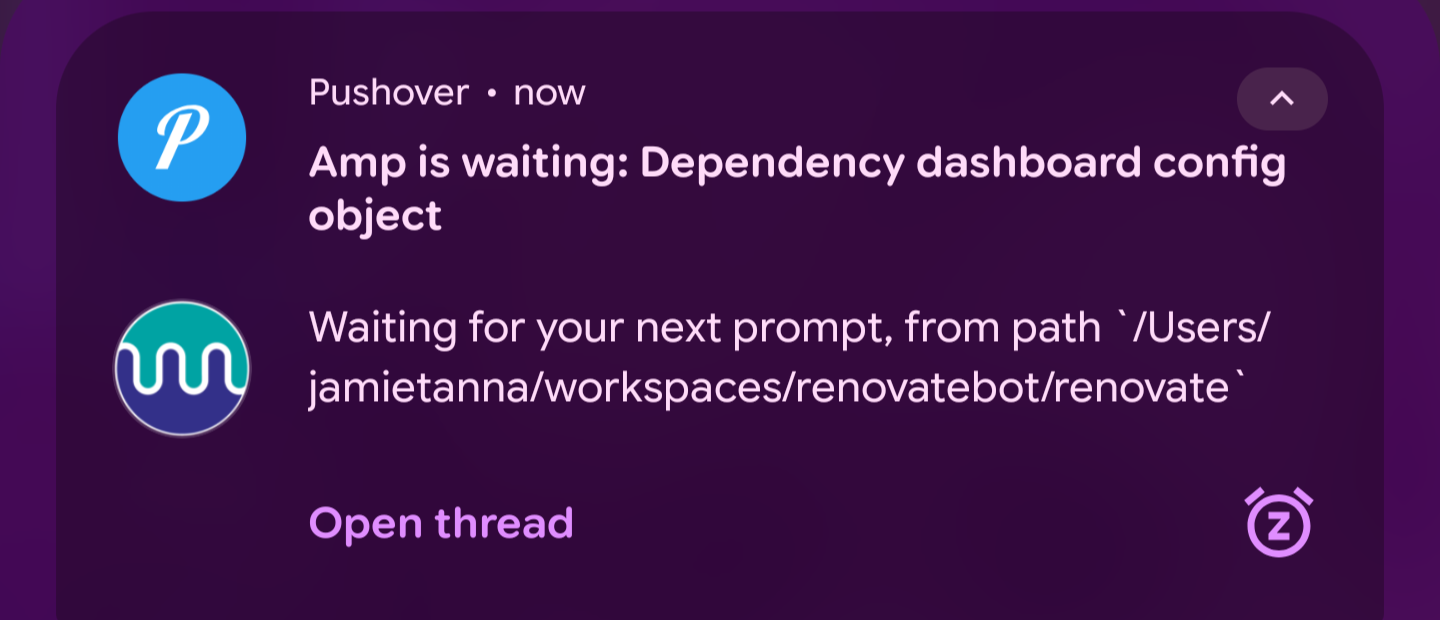
A screenshot of a Pushover notification on Jamie's Android phone. It has a title 'Amp is waiting: Dependency dashboard config object', with a description: 'Waiting for your next prompt, from path `...`. The icon for it is one of Mend's logos, as this is Jamie's work machine's Amp notifying him, which is different to the logo used on his personal devices' Amp. There's an 'Open thread' button, which opens in the web UI the Amp Thread being worked on

I've recently been using Amp a bit more, given you can now use your Claude subscription with it.

In a similar vein to Adding Pushover notifications to Claude Code, I've been wanting to get notified when a given session is waiting for input.

Although I wrote a very small CLI, claude-hook which I'd wondered about extending for Amp's usage, I found that Amp's Typescript-based plugins are much more powerful, and avoid me needing to create a wrapper CLI, even though I'd hoped to keep the codebase the same across different agent tools.

(While, at the same time, not getting as much contextual information out of the Thread, which is a bit annoying)

I partially wrote, and then had Amp + Claude Opus 5.5 fix up, this small Amp Plugin to notify me on agent.end.

This then shows me i.e.

A screenshot of a Pushover notification on Jamie's Android phone. It has a title "Amp is waiting: Dependency dashboard config object", with a description: "Waiting for your next prompt, from path .... The icon for it is one of Mend's logos, as this is Jamie's work machine's Amp notifying him, which is different to the logo used on his personal devices' Amp. There's an "Open thread" button, which opens in the web UI the Amp Thread being worked on

Written by Jamie Tanna's profile image Jamie Tanna on , and last updated on .

Content for this article is shared under the terms of the Creative Commons Attribution Non Commercial Share Alike 4.0 International, and code is shared under the Apache License 2.0.

#blogumentation #ai #llm.

πŸ€– Content in this blog post includes code derived from the following LLMs:

PurposeModelNotes
Codeclaude:opus-5.5The code (that is being referred to) is AI-generated. Although it's not referenced here, I thought I'd be clear about that
Editorial supportNo usage
Prose (verbatim or edited)No usage
Images, visualisation, data and/or metricsNo usage

This post was filed under articles.

Interactions with this post

Interactions with this post

Below you can find the interactions that this page has had using WebMention.

Have you written a response to this post? Let me know the URL:

Do you not have a website set up with WebMention capabilities? You can use Comment Parade.